

Methought - April/2026

scroll down to read the English version
Caros leitores,
Coincidentemente, esse post vai sair no dia do meu aniversário. Mais um ano escrevendo para essa newsletter e estou feliz e grata por ter quem goste de ler o que escrevo. Sempre que penso no cansaço e no trabalho que dá para fazer tudo isso, tento me lembrar do quanto é importante pra mim.
Abril foi um mês estressante (inferno astral) mas estou satisfeita com o andamento do clube. Tudo o que eu queria pedir de aniversário ao universo é que ele me dê mais capacidade de organização e uma melhora de attention span para que eu possa ler e escrever tanto quanto eu gostaria no meu mundo ideal.
Em anos anteriores eu tive mais reflexões sobre aniversário para compartilhar, mas esse ano, estranhamente, me sinto meio indiferente à data. Talvez eu esteja finalmente amadurecendo e parando de ter pânico com o envelhecer? Afinal, minhas melhores reflexões de aniversário vieram depois de muita melancolia e lágrimas e ansiedade. Esse ano me sinto perturbadoramente calma. Vou encarar como algo bom e não como apatia (até porque eu vou comemorar sim, não me entendam errado).
E aqui vai o poema do mês, que na verdade é um trecho de uma música de Joni Mitchell, que para mim é uma poeta:
I Think I Understand
Daylight falls upon the path
The forest falls behind
Today I am not prey to dark uncertainty
The shadow trembles in its wrath
I've robbed its blackness blind
And tasted sunlight as my fear came clear to me
I think I understand
Fear is like a wilderland
Stepping stones or sinking sand
Now the way leads to the hills
Above the steeple's chime
Below me sleepy rooftops round the harbor
It's there I'll take my thirsty fill
Of friendship over wine
Forgetting fear but never disregarding her…
Lembrando que no mês de maio estamos lendo Hamlet e Anna Karenina no clube Methinks! vem ler com a gente <3
Detalhes do clube do livro podem ser encontrados aqui:

LIDOS
Giovanni’s Room - James Baldwin
Uma surpresa desagradável. Eu tinha certeza de que ia adorar esse livro e não foi o caso. Primeiro que eu não gostei da escrita de Baldwin: achei excessivamente truncada, com períodos longos demais; eu sei que era uma escolha estilística intencional, mas não me agradou… achei que interrompeu a fluidez da minha leitura. Segundo que o “romance” foi uma grande decepção para mim. Talvez eu tenha ido com as expectativas erradas, mas o tratamento que Baldwin dá ao romance entre David e Giovanni é insuficiente para que eu consiga me conectar com esses personagens a ponto de me importar com a história e com o drama que ocorre entre eles. Vemos muito pouco do que poderia ser chamado de amor entre eles, e por isso eu estava era torcendo por esse término. Terceiro e último—e aí é um problema de gosto—é que eu odiei estar na mente de David; achei ele um dos piores personagens que já encontrei na literatura. Ele é mudo e insensível: de que adianta estar no POV de alguém mudo, que não reage não reflete e não fala quando confrontado com o sofrimento que ele mesmo causa? Mais uma vez, talvez seja intencional, mas não é para mim.
Os Órgãos dos Sentidos - Adam Ehrlich Sachs
E agora uma surpresa agradabilíssima. Até então, esse foi o melhor livro que li esse ano. Penso nele com alguma constância. Difícil explicar por que amei tanto visto que o motivo é fruto de um conjunto de muitos fatores específicos, mas vou tentar.
O frame narrativo foi algo que me cativou logo de cara. Existem diversas camadas de narradores nesse livro—inclusive narradores parciais que contam versões diferentes da mesma história—o que complica a compreensão do leitor quanto aos “fatos” e à “verdade” dessa história. Mas esse é todo o ponto: esse romance em si é um problema epistemológico, que tem como tema principal a impossibilidade da mente humana de saber algo de verdade, de agarrar a realidade de forma absoluta. Desse modo, a própria forma de narrar reforça e colabora para o desenvolvimento do tema. Além disso, o livro é, de certa forma, um romance histórico, pois mistura eventos e pessoas reais com ficção, um dos meus modos favoritos de storytelling. Perceba que esse é um livro não só pra quem não se incomoda com ambiguidade, mas pra quem ama ambiguidade—que nem eu. Eu amo não saber. Amo versões conflitantes e finais em aberto (quando bem construídos, óbvio).
Neste livro, que se passa em Praga no século XVII, temos o filósofo Leibniz que está escrevendo um artigo para uma revista científica (narrativa 1) sobre um astrônomo sem olhos que supostamente previu um eclipse que ninguém mais previu. Para entender como isso é possível, ele entrevista o astrônomo (narrativa 2), que por sua vez começa a contar toda a história de sua vida até levar aquele telescópio que permite que ele supostamente veja as estrelas sem olhos. Durante a entrevista, o astrônomo reconta conversas e histórias que foram contadas para ele, e se não me engano, teremos depoimentos (repassados pelo astrônomo) de outros cinco personagens, todos eles contando versões conflitantes dos eventos, sendo eles os narradores restantes. É lindo: temos alguém contando uma história pro astrônomo, que conta pra Leibniz, que registrou isso em latim e depois foi traduzido para o alemão. Eu não sei que parte dessa narrativa é ficção e que parte é “fato”. E nem os próprios personagens sabem.
O final foi muito satisfatório e inesperado, e amarra muito bem os problemas epistemológicos, bem como problemas sobre o que é a loucura e quem pode definir quem é louco e quem é são. A estrutura do romance é de uma proeza técnica invejável—queria ter escrito isso.
As You Like It - William Shakespeare
Uma maravilhosa peça primaveril, perfeita para ler em Abril e provar que ele não é o mais cruel dos meses. Adorei reler e prestar atenção nas inversões e paródias do gênero Pastoral, bem como aprender mais sobre o papel histórico do bobo da corte e da comédia no teatro e na cultura da época num geral. Tudo isso você pode ler aqui:
ASSISTIDOS
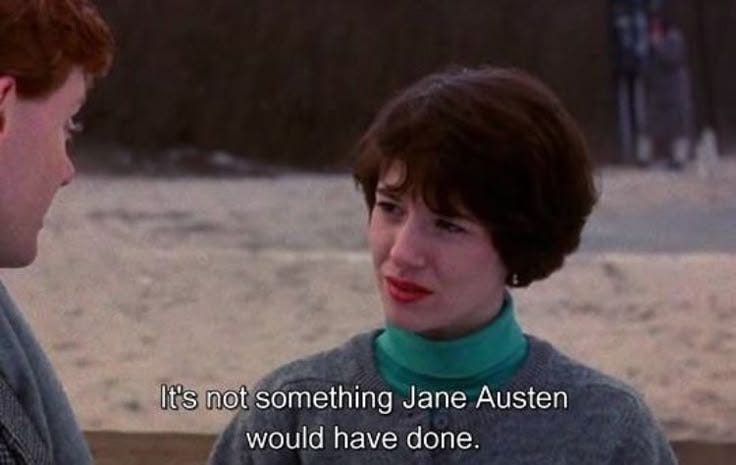
Metropolitan - Whit Stillman (1990)
Eu gosto bastante de um tipo bem específico de filme: possivelmente filmado em película, com uma imagem granulada, em tons neutros (se for colorido, é numa paleta deliberadamente pouco diversa), e com um visual aconchegante; que depende muito do roteiro para ser composto majoritariamente de diálogos interessantes; pouco precisa acontecer na trama; relacionamentos normalmente são complicados; de preferência eu vou sair com ao menos uma aba aberta no Google pesquisando alguma referência feita no filme.
Esse é um resumo das comédias proverbiais de Rohmer, (de alguns) de Varda, e de W**** A**** das décadas de 80 e 90. Metropolitan se aproxima bastante deste último, chegando perto de oferecer uma alternativa aos filmes daquele homem os quais eu infelizmente tanto amo—mas faltou alguma substância; não chegou perto o suficiente: faltou neurose; mesmo que a apatia seja o ponto, tem como ilustrar a apatia de forma menos apática.
A história se passa durante o Natal e Ano Novo e é sobre um grupo de U.H.B.s (Urban Haute Bourgeoisie) novaiorquinos entediados que transitam entre bailes de debutantes, conversas pseudo-intelectuais em salas do Upper East Side e affairs malfadados. A falta de propósito de quem tem tudo é o tema central, e essa melancolia ingrata e patética é o que faz o espectador rir (ainda que com alguma empatia). É bom para a classe média rir dos ricos e desprezá-los e pensar em como eles certamente fariam melhor uso desse privilégio.
É um filme meio mal cozido, mas nota-se que tinha potencial. Ainda assim eu gostei. Certamente verei The Last Days of Disco do mesmo diretor.
The Drama - Kristoffer Borgli (2026)
O que a sua cara-metade teria de fazer para que você deixasse de reconhecê-la como a pessoa que você ama? E até, por isso, deixar de amá-la? Essa é a principal pergunta do filme e uma que acho fascinante. Grande premissa e que foi executada muito bem, principalmente na atuação de Zendaya. Gosto que o filme toca em polêmicas da cultura bizarra e absurda dos Estados Unidos sem se tornar algo clichê ou didático. É um ótimo filme para ver acompanhado e depois debater sobre o que você teria feito na situação desses personagens.
Splitsville - Michael Angelo Covino (2025)
Não achei que eu fosse gostar tanto desse filme mas eu adorei! Eu ri muito. Ele aborda com ótimo senso de humor a nova moda dos relacionamentos abertos, sem passar julgamentos demais. Os dois casais disfuncionais desse filme são meu pior pesadelo, me deram muita vergonha alheia, mas me divertiram horrores.
Synecdoche, New York - Charlie Kaufman (2008)
Posso anunciar oficialmente que odeio Charlie Kaufman, tendo agora visto e desgostado de três filmes dele, apesar de eu achar esse o melhor dos três. Como sempre, uma ótima premissa—um dramaturgo decide transformar a própria vida numa peça com absurdas consequências metalinguísticas—mas executada de forma irritante, insuportável, autoindulgente, masturbatória e entediante. Não recomendo. A não ser que você seja um homem patético que não toma banho mas que ainda assim se acha melhor que os outros.
DTF St Louis 1ª temporada - HBO (2026)
Tive muitos altos e baixos com essa série. Gostei da premissa, mas odiei o primeiro episódio e aí desisti. Depois vi muita gente falando super bem e resolvi dar outra chance, e desisti de novo no segundo. E então a série acabou e saíram várias reviews incrivelmente elogiosas, dei a terceira chance e então acabei gostando muito… até o final, que achei em parte previsível e um pouco anticlimático, apesar de emocionante em alguns momentos. DTF St Louis é sobre dois amigos que resolvem baixar um app de relacionamentos para pessoas casadas, e um deles é assassinado num suposto encontro marcado nesse app. A partir daí a série é contada em vários flashbacks, intercalando com a investigação. A narrativa é ambígua de um jeito que demonstra uma confiança no espectador, como poucas séries confiam atualmente.
O que mais gostei dessa série foi a absoluta banalidade dos personagens e suas carreiras; pessoas abertamente patéticas e inseguras retratadas de forma extremamente genuína, o que achei refrescante na televisão. Além disso, acho que nunca vi uma amizade masculina (ou amor platônico entre homens) ser representada desse jeito—e que jeito é esse eu não posso descrever porque seria spoiler. Basta dizer que foi feito de um jeito muito honesto e sensível, ridículo também, mas faz parte da honestidade; e acima de tudo interessante. Vale ver essa série pela dinâmica de relacionamentos extremamente única, não tanto pelo suspense.
Os outros filmes que assisti em abril:
Little Women - Greta Gerwig (2019) 5/5
If I had Legs I’d Kick You - Mary Bronstein (2025) 2.5/5
Blade Runner 2049 - Denis Villeneuve (2017) 4/5
The French Dispatch - Wes Anderson (2021) 3.5/5
ESCUTADOS
Journal of Ardency - Class Actress (2010)
Isso é clubbing com classe; dançar enquanto pondera sobre as implicações sociais do ato. Algumas me lembram música de videogame o que às vezes odeio, outras amo. Músicas favoritas: Careful what you say; Journal of Ardency; Terminally chill.
What a Beautiful Place - Catherine Howe
Se você gosta de Joni Mitchell, você vai gostar de Catherine Howe. Muitas das músicas incorporam violinos e orquestras, o que gosto bastante. Ela não é uma liricista tão boa quanto Joni, mas ainda assim encanta. Vale ouvir o álbum todo numa sexta à noite com uma garrafa de vinho.
Astral Weeks - Van Morrison (1968)
Mais um álbum do tipo rock-pastoral/folk-country que eu amo de paixão. Provavelmente é o tipo de música que mais escuto. Se você gosta de Nick Drake e George Harrison, esse álbum especificamente é pra você. Músicas favoritas: Astral Weeks; Cyprus Avenue; Slim Slow Slider; The Way Young Lovers Do.
Dear readers,
Coincidentally, this post will be published on my birthday. Another year around the sun and writing for this newsletter, and I’m happy and grateful to have people who enjoy reading what I write. Whenever I think about how tiring it is and how much work goes into doing all this, I try to remind myself just how important it is to me.
April was a stressful month (astrological hell), but I’m pleased with how the club is going. All I wanted to ask the universe for my birthday is for it to give me better organising skills and an improved attention span so that I can read and write as much as I’d like in my ideal world.
In previous years, I had more birthday reflections to share, but this year, strangely, I feel rather indifferent to the date. Perhaps I’m finally maturing and getting over my panic about getting older? After all, my best birthday reflections came after a lot of melancholy and tears and anxiety. This year I feel unsettlingly calm. I’m going to take this as a good thing rather than apathy (not least because I will be celebrating, don’t get me wrong).
And here is the poem of the month, which is actually an excerpt from a song by Joni Mitchell, who to me is a poet:
I Think I Understand
Daylight falls upon the path
The forest falls behind
Today I am not prey to dark uncertainty
The shadow trembles in its wrath
I’ve robbed its blackness blind
And tasted sunlight as my fear came clear to me
I think I understand
Fear is like a wilderland
Stepping stones or sinking sand
Now the way leads to the hills
Above the steeple’s chime
Below me sleepy rooftops round the harbor
It’s there I’ll take my thirsty fill
Of friendship over wine
Forgetting fear but never disregarding her…
Just a reminder that this May we’re reading Hamlet and Anna Karenina at the Methinks! book club! Come and read with us <3
Details of the book club can be found here:
READ
Giovanni’s Room - James Baldwin
An unpleasant surprise. I was sure I’d love this book, but that wasn’t the case. Firstly, I didn’t like Baldwin’s writing style: I found it excessively disjointed, with overly long sentences/clauses; I know it was an intentional stylistic choice, but I didn’t like it… I felt it disrupted the flow of my reading. Secondly, the ‘romance’ was a huge disappointment for me. Perhaps I went into it with the wrong expectations, but Baldwin’s treatment of the romance between David and Giovanni is insufficient for me to connect with these characters to the point of caring about the story and the drama unfolding between them. We see very little of what could be called love between them, and for that reason I was actually rooting for it to end. Thirdly and finally—and this is a matter of taste—I hated being inside David’s head; I found him one of the worst characters I’ve ever encountered in literature. He is silent and insensitive: what’s the point of being in the POV of someone who is silently unresponsive, unreflective and unmoved when confronted with the suffering he himself causes? Once again, perhaps it’s intentional, but it’s not for me.
The Organs of Sense - Adam Ehrlich Sachs
And now for a most delightful surprise. So far, this has been the best book I’ve read this year. I find myself thinking about it quite often. It’s hard to explain why I loved it so much, as the reason stems from a combination of many specific factors, but I’ll give it a go.
The narrative framework was something that captivated me right from the start. There are several layers of narrators in this book—including biased narrators who tell different versions of the same story—which complicates the reader’s understanding of the ‘facts’ and the ‘truth’ of this story. But that is precisely the point: this novel itself is an epistemological problem, whose main theme is the human mind’s inability to know anything for certain, to grasp reality in an absolute sense. In this way, the very form of narration reinforces and contributes to the development of the theme. Furthermore, the book is, in a way, a historical novel, as it blends real events and people with fiction—one of my favourite forms of storytelling. Note that this is a book not just for those who aren’t bothered by ambiguity, but for those who love ambiguity—like me. I love not knowing. I love conflicting versions and open endings (when well-constructed, obviously).
In this book, set in 17th-century Prague, we have the philosopher Leibniz writing an article for a scientific journal (narrative 1) about a blind astronomer who supposedly predicted an eclipse that no one else had foreseen. To understand how this is possible, he interviews the astronomer (narrative 2), who in turn begins to recount the whole story of his life, right up to the point where he acquired that telescope which supposedly allows him to see the stars without eyes. During the interview, the astronomer recounts conversations and stories that were told to him, and if I am not mistaken, we will have accounts (relayed by the astronomer) from five other characters, all of them telling conflicting versions of the events, and they are the remaining narrators. It’s beautiful: we have someone telling a story to the astronomer, who tells it to Leibniz, who recorded it in Latin and it was later translated into German. I don’t know which part of this narrative is fiction and which part is ‘fact’. And not even the characters themselves know.
The ending was very satisfying and unexpected, and ties up the epistemological issues very well, as well as questions about what madness is and who can define who is mad and who is sane. The structure of the novel is an enviable technical feat—I wish I’d written it.
As You Like It - William Shakespeare
A wonderful springtime read, perfect for reading in April and proving that it isn’t the cruellest of months. I loved re-reading it and paying attention to the inversions and parodies of the pastoral genre, as well as learning more about the historical role of the court jester and comedy in theatre and the culture of the time in general. You can read all about it here:
WATCHED
Metropolitan - Whit Stillman (1990)
I’m really into a very specific kind of film: ideally shot on film, with a grainy image, in neutral tones (if it’s in colour, it’s in a deliberately limited palette), and with a cosy feel; one that relies heavily on the script to consist mainly of interesting dialogue; little needs to happen in the plot; relationships are usually complicated; ideally, I’ll leave the cinema with at least one tab open on Google, looking up a reference made in the film.
This is a summary of the proverbial comedies of Rohmer, (some of) Varda’s, and W**** A****’s from the 80s and 90s. Metropolitan comes very close to the latter, almost offering an alternative to the films of that man I unfortunately love so much—but it lacked some substance; it didn’t come close enough: it lacked neurosis; even if apathy is the point, there are ways to illustrate apathy in a less apathetic manner.
The story is set over Christmas and New Year and is about a group of bored New York U.H.B.s (Urban Haute Bourgeoisie) who drift between debutante balls, pseudo-intellectual conversations in Upper East Side salons and ill-fated affairs. The lack of purpose among those who have everything is the central theme, and this ungrateful, pathetic melancholy is what makes the viewer laugh (albeit with some empathy). It’s good for the middle class to laugh at the rich and look down on them, and to think about how they would certainly make better use of that privilege.
It’s a bit of an undercooked film, but you can tell it had potential. Still, I enjoyed it. I’ll certainly be watching The Last Days of Disco by the same director.
The Drama - Kristoffer Borgli (2026)
What would your better half have to do for you to stop recognising them as the person you love? And, indeed, to stop loving them altogether? That is the film’s central question, and one I find fascinating. It’s a great premise and it’s executed very well, particularly thanks to Zendaya’s performance. I like that the film touches on controversies within the bizarre and absurd culture of the United States without becoming clichéd or preachy. It’s a great film to watch with someone and then discuss what you would have done in the characters’ situation.
Splitsville – Michael Angelo Covino (2025)
I didn’t think I’d like this film so much, but I loved it! I laughed a lot. It tackles the new trend of open relationships with a great sense of humour, without being overly judgemental. The two dysfunctional couples in this film are my worst nightmare; they made me cringe on their behalf, but I had a brilliant time watching them.
Synecdoche, New York - Charlie Kaufman (2008)
I can officially announce that I hate Charlie Kaufman, having now seen and disliked three of his films, even though I think this is the best of the three. As always, a great premise—a playwright decides to turn his own life into a play with absurd metalinguistic consequences—but executed in an irritating, unbearable, self-indulgent, masturbatory and tedious way. I don’t recommend it. Unless you’re a pathetic man who doesn’t bathe but still thinks he’s better than everyone else.
DTF St Louis Season 1 - HBO (2026)
I had a real love-hate relationship with this series. I liked the premise, but I hated the first episode and gave up on it. Then I saw loads of people raving about it, so I decided to give it another go, only to give up again after the second episode. Then the series finished and loads of incredibly glowing reviews came out, so I gave it a third chance and ended up really enjoying it… right up until the end, which I found partly predictable and a bit of an anticlimax, though it was moving at times. DTF St Louis is about two friends who decide to download a dating app for married people, and one of them is murdered on a supposed date arranged through the app. From there, the story is told through a series of flashbacks, interspersed with the investigation. The narrative is ambiguous in a way that shows a trust in the viewer that few shows demonstrate today.
What I liked most about this series was the utter banality of the characters and their careers; openly pathetic and insecure people portrayed in an extremely genuine way, which I found refreshing on television. Furthermore, I don’t think I’ve ever seen a male friendship (or platonic love between men) portrayed in this way—and I can’t describe exactly how because it would be a spoiler. Suffice to say it was done in a very honest and sensitive way, ridiculous too, but that’s part of the honesty; and above all, interesting. It’s worth watching this series for the extremely unique dynamics of the relationships, not so much for the suspense.
Other films I’ve watched in April:
Little Women - Greta Gerwig (2019) 5/5
If I had Legs I’d Kick You - Mary Bronstein (2025) 2.5/5
Blade Runner 2049 - Denis Villeneuve (2017) 4/5
The French Dispatch - Wes Anderson (2021) 3.5/5
LISTENED TO
Journal of Ardency - Class Actress (2010)
This is clubbing with class; dancing yet pondering the social experience of it. Some songs remind me of a videogame soundtrack, which I sometimes hate and others love. Favorite songs: Careful what you say; Journal of Ardency; Terminally chill.
What a Beautiful Place - Catherine Howe
If you like Joni Mitchell, you’ll like Catherine Howe. Many of the songs feature violins and orchestras, which I really enjoy. She isn’t quite as good a lyricist as Joni, but she’s still enchanting. It’s well worth listening to the whole album on a Friday night with a bottle of wine.
Astral Weeks - Van Morrison (1968)
Another one of those pastoral rock/folk-country albums that I absolutely adore. It’s probably the sort of music I listen to most. If you like Nick Drake and George Harrison, this album in particular is for you. Favourite tracks: Astral Weeks; Cyprus Avenue; Slim Slow Slider; The Way Young Lovers Do.